
Scaling Operations Without Sacrificing Quality










As more clients come in, more campaigns will be created, more reporting activities will occur, more meetings will take place, and more decisions will be made in the day-to-day. Initially, all people can probably sustain it by working a little harder. However, over time, this strategy quickly comes to an end. Deadlines start to become more restrictive, details are overlooked, and the service that clients are expecting is more difficult to provide.
It’s not always a case of growth control. It’s about creating an operation that will be able to do more work without relying on the same individuals to do it.
Know What to Keep
Not all work has to be performed onsite.
The ownership of client relationships, strategic decisions, positioning, and account direction is where the agency knows best. They might be able to find someone to handle repetitive execution work, campaign management, reporting assistance, or specialized media-buying.
The key point is not just “what can we outsource? It’s the question of where our team is generating the most value.
With such a separation in mind, agencies can preserve their strengths and develop new accounts.

Build Before You Grow
It’s almost never a good idea to put a client on an already uncoordinated operation.
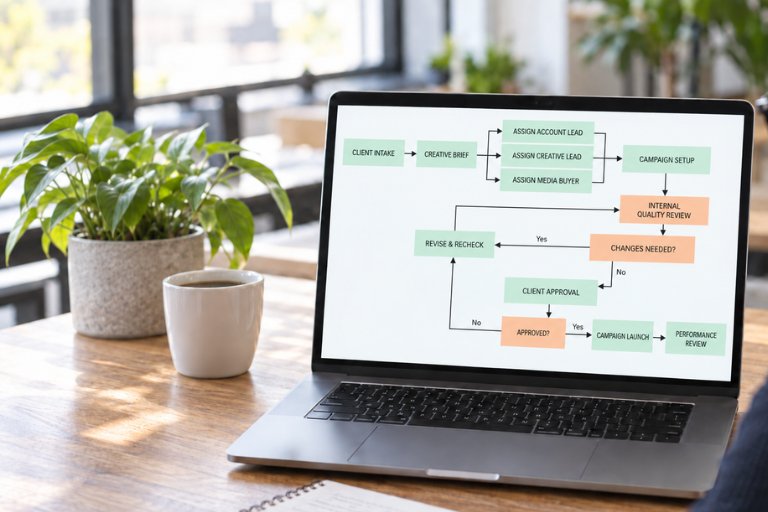
Prior to scaling activity, see how work flows through the agency. Which person is assigned the short? Who launches campaigns? By whom is the work being reviewed? What steps along the process require people’s approval? What do you do if you need to change something?
These handoffs can be more easily managed with clear processes. They will also decrease the amount of information in “headbutt-only” formats.
While a documented workflow might not sound like much fun, it can be incredibly useful if multiple people are servicing different accounts.
Put Quality Checks First
Quality control should not be done after a client complains of a “problem.
Establish review points in advance of work delivery to the client. Clear ownership of campaign settings and creative assets, with clearly defined checks, should be established, as well as tracking, targeting, budgets, and reporting.
It’s the same when you use one of your white label partners. It is important for both teams to have an understanding of what ‘ready to deliver’ is before the work is passed on.
A proper quality control process does not have to hinder an agency. In many situations, it eliminates the need for rework that is the root cause of delays.

Choose Partners Carefully
White-label support can provide an agency with extra expertise without having to develop each of them in-house. The right partner, however, can help ease management issues, but the wrong one can actually add to them.
Think outside the box when choosing a partner’s services. Look for aspects of communication, reporting, turnaround time, campaign knowledge, and responsibility clarity.
The relationship should be like a part of your team. Your client won’t necessarily meet with the white label provider, but the work that they produce will impact the reputation of your agency.

Scale Without Losing Trust
Clients are typically not interested in the inner workings of the agency. They’re concerned about their experience.
As the agency becomes bigger, communication slows down, and the quality of the campaign begins to drop, clients will notice. This is why there’s more to scaling than simply increasing the number of new accounts an agency can handle.
The challenge to the agency is to keep growing while continuing to be responsive, strategic, and of high quality with those same clients.

Scaling Operations Without Sacrificing Quality
Ready to Scale With More Control?
Agency growth shouldn’t mean choosing between taking on more business and maintaining the quality clients expect. The right processes, clear responsibilities, and dependable operational support can make both possible.
With strategic media buying and white-label support, Brill Media gives agency teams the capacity they need to grow their digital advertising and keeps them focused on client service and growth.

Scaling Operations Without Sacrificing Quality
Supercharge your performance media buying 🚀