How Programmatic Advertising Works

How Programmatic Advertising Works

In previous post we discussed History of Demand Side Platforms and Benefits Of Demand Side Platforms. These are tools used by advertisers and their agencies to activate and optimize advertising campaigns. In this post we’ll share additional context about DSPs, and dive into programmatic advertising.

Programmatic advertising is a very loaded word, and because it has so many layers attributed to it, we have often stopped using this phrase. But we’ll get into it, talk about what it is, how it’s used, and why the phrase is being phased out in many corners of the advertising world.

What Is Programmatic Advertising?

Programmatic advertising is the use of data, software and automation to make smart advertising decisions. That’s the simplest definition of this very loaded term.

How Programmatic Advertising Works

Let’s dive into the details. When advertising is bought in 2020 there is usually an ecosystem of connections that make the ad buying possible. For example, I can go to a platform like The Trade Desk and MediaMath to buy an ad on a publisher like Yahoo, Food Network, or Flixster. For me to make that transaction I will use data from a company, possibly Mastercard, Oracle, or Nielsen. The ad will run through an intermediary, called an ad exchange or supply side platform, and the ad will run on the sites I mentioned. The programmatic ecosystem is that infrastructure, and allows those connections to happen with virtually infinite combinations.

If you want to see the companies that comprise the programmatic ecosystem look at this Lumascape. Luma Partners is a firm run by Terence Kawaja. They are a strategic advisory firm that helps companies with, among other things, mergers and acquisitions. For example, they helped facilitate the transaction between Foursquare and Factual.
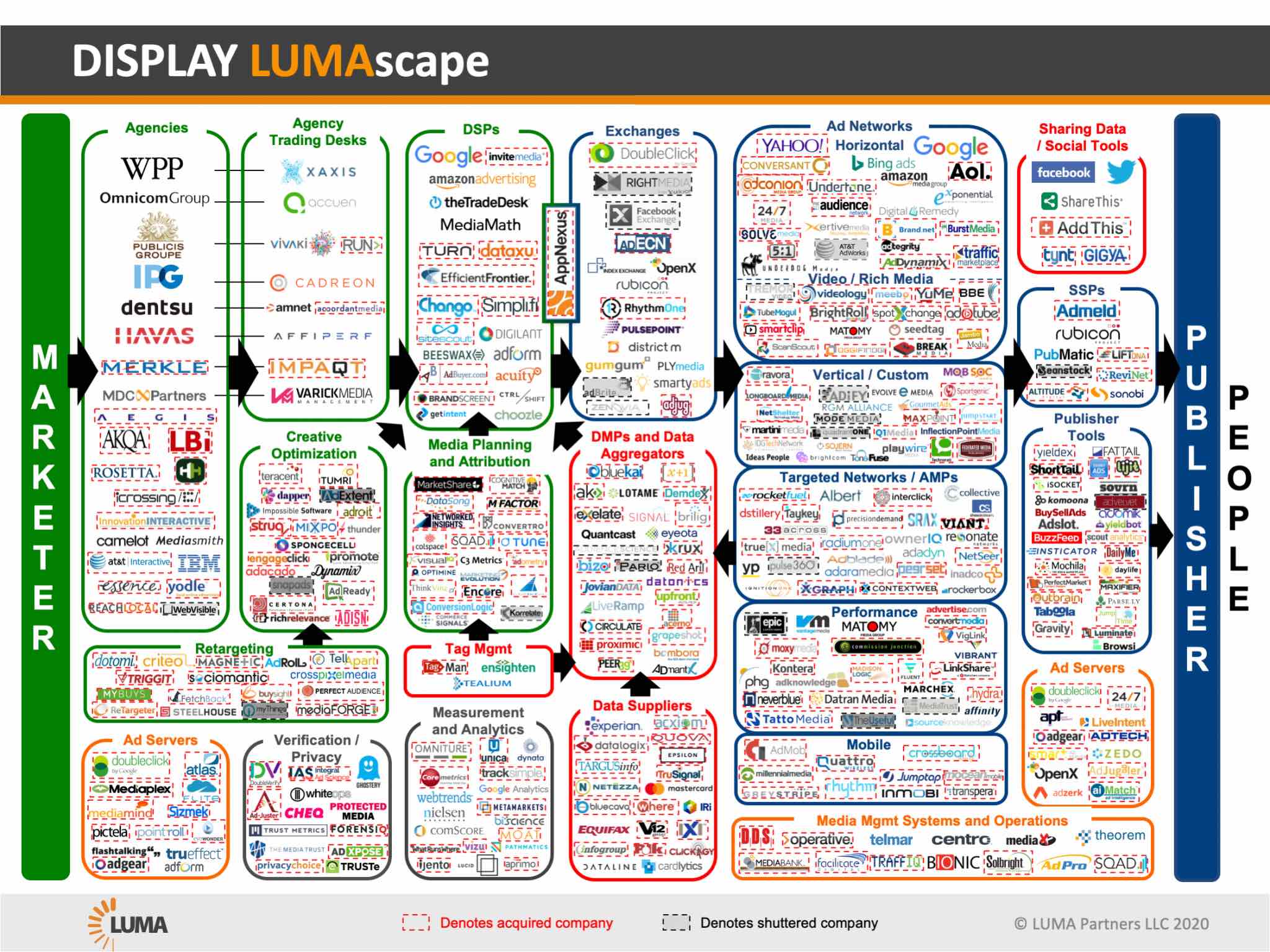
Lumascape View Of Programamtic 

I counted the logos. There are over 300 logos on this sheet representing companies that make up this ecosystem. Certainly there are mergers and acquisitions happening all the time, so the true count of companies participating in the programmatic ecosystem is always fluctuating.

What you’ll see on this chart are a whole slew of company types. I’ll call some out. You have advertising agencies, which do your typical work of setting up strategies, defining audiences, developing creative, and buying advertising space. You then have trading desks. These are companies whose job is to be hands on keyboard for the tools that help advertisers buy inventory. These are the DSPs, which we covered. I’ll stop right here, and say that if you are reading this and you want to know more about how to build a trading desk you can check out our 2020 Advertiser Trading Desk Success Guide. It’s over 30 pages and breaks down the process to build an agency trading desk into five steps.

We are a trading desk, although you won’t often hear us talk about ourselves with that term, because unless you are part of the programmatic ecosystem, that term, also, just like the term programmatic, is loaded and causes too much confusion.

You’ll see the ad exchanges, ad networks, supply side platforms, social platforms, ad servers, data suppliers, dynamic creative tools, and whole slew of other companies that are part of this ecosystem.

What makes this ecosystem particularly durable is the fact that companies can build on top of it. For example, if I want to start selling data, there are companies that exist that allow me to use their infrastructure to go from having a product idea, to actually selling that data product. I’m not saying the process is easy, but I am saying that a new data company doesn’t have to build all the connections by hand. What this also does is lower the barrier to entry for companies who have new and innovative products, thereby increasing competition, and providing opportunities for all manner of entrepreneurs.

So, to recap, the programmatic ecosystem really creates a pathway for advertisers large and small to reach consumers. If you want the full recap of advertiser benefits watch the video called 8 DSP Benefits. This write-up reviews the benefits to advertisers. 

There are different value propositions that publishers are looking for. And, since I haven’t spent any substantial time working for publishers in my career I can’t give you too much insight. What I will say is that supply side platforms, or SSPs, are designed to give publishers an opportunity to maximize their revenue through the benefit of maximizing the amount of sold inventory, maximizing the CPM that advertisers pay for that inventory, and using data to understand the best combination of those two factors. This really comes back to supply and demand economics. Price the ad inventory too high and there will be a fewer buyers, therefore diminishing overall revenue. Price the ad inventory too low, and there will be many buyers, but overall revenue diminishes because buyers aren’t paying enough on a per impression basis. Find the right middle ground, and you maximize your revenue.

Three Overall Uses For Programmatic

1. For Advertisers

There are three overall uses for the programmatic ecosystem. The one that’s most interesting to me, considering that we sit on the demand side, or the advertiser’s side, is the opportunity to buy ad inventory with precision, scale, labor efficiency, and campaign effectiveness. 

Remember, that 85% of display advertising is being transacted through the programmatic ecosystem, so chances are, if you are running advertising in 2020 you are buying through the programmatic ecosystem, including with ads on social platforms. In fact, if you don’t have access to one of the major DSPs, first of all you should reach out to us and we can help you there. In some cases our business acts as a white label for other advertising companies. The advertiser doesn’t know that BrillMedia.co exists, but the agency is using us to power their digital ad buying. But, if you don’t use these tools, and you are buying ads through Facebook, for example, you are a participant in the programmatic ecosystem. The reason I bring this up is because Facebook is a really powerful demand side platform. If you want to know the functionality of demand side platforms, you see a great example of it in Facebook. Another example of it is Google Ads. Both of these platform use data and automation and allow businesses to reach consumers with ads. Data is used for targeting. Reporting is used to gather intelligence and setup optimization decisions. Inventory is readily available in the platform.

2. For Inventory Owners

The second overall use is for ad inventory owners to monetize. With the exception of some trade publications, like DentalTown.com, for example, most publications are available through the programmatic ecosystem. Publications use the ecosystem because 85% of ads are transacted through programmatic tools, which means if you aren’t participating, you are closed off to 85% of the marketplace. So, it’s part of the deal: if you want to be a seller of ad inventory in 2020 it’s a safe bet that you’ll probably be in the programmatic ecosystem. The trade publications don’t participate because they have a very small reader base who are in a specific vertical, like dentistry, and the advertisers go direct to them to buy ad space. Because of the specialty nature of the publication, they can charge higher overall rates than they’d get on the programmatic ecosystem (although there are ways to maintain those rates), and advertisers work directly with the publisher in the same way that advertising happened in 2005.

3. The Buy Side And Sell Side Services

The third group the programmatic ecosystem services is the intermediary businesses that support buyers or sellers with tools that make the job easier. For example, a company called Adacado makes dynamic ad creative happen with simple tools that are designed for small businesses. Flash Talking and Celtra make dynamic creative targeting happen for larger enterprises. But, neither of these tools would have an easy go of it if the pathways were not already laid in the programmatic ecosystem. Programmatic is like the network of roads and bridges we have in the US. Anyone can use them, taxes pay for their creation and upkeep, and anyone can build a hotel, home, or hospital along the roadways. Without the roadways the buildings would be kind of out in the middle of nowhere, with no good way for people to get there. So, the builder would have to then build their own roads, making it unnecessarily costly just to get people to a hotel, home, or hospital. 

Programmatic is the standardized connection between these 300+ companies that makes the business run smoothly, and powers about a $63B industry.

The final part of this write-up will talk about why we don’t use the jargon around programmatic, and why in general across the industry it’s going away.

The simplest explanation is that it’s confusing, takes too much time to explain, and you’re never really sure if the person you’re talking to understands programmatic the same way you do. This happens at all levels of the business. If I talk about programmatic I’m including Facebook. If I propose running a programmatic campaign, which is everything we do, I may mean banners and Facebook ads. My client may take programmatic to be banners and inventory outside of the social platforms. So, right there we have miscommunication. So, when we talk about our business we talk with more specificity. If we want to run campaigns we talk about banners, Facebook, Instagram, and video ads.

When I started developing our product base for our business early on, going as far back as 2013, I remember talking to people about programmatic, and seeing that gloss come over the other person’s eyes. It’s hard to sell programmatic. It’s much easier to sell banners, Facebook, video, and hyperlocal. In the first few years I found that people responded well to the term hyperlocal, so for many years we prominently talked about our capabilities around hyperlocal advertising.

Economics

So, in aggregate the term programmatic becomes the defacto way of buying digital advertising in 2020, and it’s not just across what most people consider digital media. All of this also applies to digital signs, digital radio, and connected TV ads. We’ll do a separate video on that. And, let’s take it a step further.

Digital Ad Spending Forecast From eMarketer 2020 

According to eMarketer all US advertising in 2020 is expected to be $225B. $134B of that spending is happening with digital media overall. This is as of June 2020, so some Coronavirus slowdown is taken into account. That puts digital media at 59% of all US ad spending in 2020. 

Display And Search Ad Spending 2020 

If you breakdown how digital ad spending is setup, there are two main buckets: search and display. Search accounts for $54B, and display accounts for $74B. Search ads can be bought in the same way banners are, through a self service hands on keyboard software. Just login and you can buy search ads. Search was programmatic before it was called programmatic: data, software, and automation. Programmatic is 85% of display advertising, or $63B. That adds up to $117B in advertising in the US that is bought through a programmatic framework, or 52% of all US ad spending in 2020.

This trend will continue to push more towards digital channels. TV ad spending, once the dominant medium in the US, has ranged in the $60B in ad spending from 2008 to 2015, got to $72B in the 2018, dropped to $70B in 2019, and is having a particularly tough year in 2020, down 15% to $60B. TV will continue to decline after an expected sharp increase in 2021, rebounding from Covid-19 disruption. Meanwhile digital, while down from prior forecasts in 2020, is still up 1.7% from 2019, and it’s expected to be up anywhere from 8% to 21% in the coming few years.

At this point, as connected TV is transacted through programmatic tools, out of home ads, and digital radio ads, more than half of advertising is bought programmatically. I argue that it’s reasonable to say that programmatic is synonymous with digital advertising, which is quickly becoming just advertising, and today accounts for more than half of all US ad spending.

Programmatic is important, the term is going away, and the mechanics of the programmatic marketplace continue to power the overall US advertising ecosystem.

Video Transcript: How Programmatic Advertising Works

Welcome to episode number 58 of The Great Reset. My name is Robert Brill and I'm the CEO of BrillMedia.co. We're an advertising firm that helps companies achieve business results with the best paid media, data, and targeting available in the marketplace.

In the last two episodes, we went into detail about demand-side platforms or DSPs. These are tools used by advertisers and their agencies to activate and optimize advertising campaigns. In this video, we'll share additional context about DSPs and dive into programmatic advertising.

Programmatic advertising is a very loaded word. It's sort of like a loaded baked potato. Sour cream, chives, butter, bacon, salt.

There's a lot going on there. And because it has so many layers attributed to it, we have often stopped using this phrase, programmatic advertising. But we'll get into it in this video and talk about what it is, how it's used, and why the phrase is being phased out in many corners of the advertising world.

Programmatic advertising is the use of data, software, and automation to make smart ad-serving decisions. So that's the simplest definition. You can stop right there and say that's the definition of programmatic advertising.

You are factually correct. Let's dive into the details, though. When advertising is bought in 2020, there's usually an ecosystem of connections that make the ad buying possible.

So, for example, I can go to a platform like The Trade Desk or MediaMath to buy an ad on a publisher like Yahoo, Food Network, or Flickster. For me, to make that transaction, I will use data from a company, possibly MasterCard, Oracle, or Nielsen. The ad will run through an intermediary called an ad exchange or a supply-side platform, and the ad will run on the sites I mentioned.

The programmatic ecosystem is that infrastructure and allows those connections to happen with virtually infinite combinations. If you want to see the companies that comprise the programmatic ecosystem, look at this Lumascape. So, Luma Partners is a firm run by Terry Kawaja.

They're a strategic advertising firm that helps companies with, among other things, mergers and acquisitions. So, for example, they help facilitate the transaction between Foursquare and Factual. I counted the logos, and there are over 300 logos on this sheet representing companies that make up this ecosystem.

Certainly, there are mergers and acquisitions happening all the time, so the true count of companies participating in the programmatic ecosystem is always fluctuating. What you'll see on this chart are a whole slew of company types, and I'll call some out. You have advertising agencies, which do your typical work of setting up strategies, defining audiences, developing creative, and buying advertising space.

And then you have trading desks. These are companies whose job it is to be hands-on keyboard for the tools that help advertisers buy inventory. These tools are the DSPs, which we covered.

And I'll stop right here, and I'll say that if you're watching this and you want to know more about how to build a trading desk, you can check out our 2020 Advertiser Trading Desk Success Guide. It's over 30 pages long, and breaks down the processes to build an agency trading desk, and breaks it down to five different steps. We are a trading desk, and although you won't often hear us talk about ourselves as a trading desk, because unless you're part of the programmatic ecosystem, that term also, just like the term programmatic, is loaded and causes way too much unnecessary confusion.

You'll see the ad exchanges on this Lumiscape ad network supply-side platforms, social platforms, ad servers, data suppliers, dynamic creative tools, and a whole stool of other companies that are part of this ecosystem. What makes this ecosystem particularly durable is the fact that companies can build on top of it. For example, if I want to start selling data, there are companies that exist that allow me to use their existing infrastructure to go from having a product idea, I want to sell data, to actually selling the data product to data buyers.

I'm not saying the process is easy or without challenges, but I am saying that a new data company doesn't have to build all the connections by hand. What this also does is lower the barrier to entry for companies who have new and innovative products, thereby increasing competition and providing opportunities for all manner of entrepreneurs. So to recap, the programmatic ecosystem really creates a pathway for advertisers, large and small, to create ways to reach consumers.

If you want the full recap of advertiser benefits, watch the video called 8 DSP Benefits to get some more insight into demand-side platforms and why they're good for advertisers and how they're good for advertisers. This video reviews the benefits to advertisers. And now there are different value propositions that publishers are looking for separately.

So we talked about advertisers. Now when we transition over to publishers, I haven't spent a lot of time working for publishers or with publishers in my career. So I can't give you too much insight, but what I can say from the outside looking in is that supply-side platforms or SSPs are designed to give publishers an opportunity to maximize their revenue through the benefit of maximizing the amount of sold inventory, maximizing the CPM that advertisers pay for that inventory, and using data to understand the best combination of those two factors.

And all this really comes back to supply and demand economics. I'm really glad I took that one and a half economics courses in college. Price the ad inventory too high, and there will be fewer buyers, therefore diminishing overall revenue.

If you price the ad inventory too low, there will be many buyers, but the overall revenue diminishes because they aren't paying enough on a per-impression basis. But if you find the right middle ground, you maximize your revenue as a publisher. There are three overall uses for the programmatic ecosystem.

The one that's most interesting to me is considering that we sit on the demand side or the advertiser side is the opportunity to buy ad inventory with precision, scale, labor efficiency, and campaign effectiveness. Remember that 85% of display advertising is being transacted through the programmatic ecosystem. So chances are, if you run advertising in 2020, you are buying through the programmatic ecosystem, including with ads on social platforms.

In fact, if you don't have access to one of the major DSPs, first of all, you should reach out to us because we can definitely help you there. In some cases, our business acts as a white label for other advertising companies. The advertiser, the end client, doesn't know that they're working with BrillMedia.co, but the agency is using us, our group, to power their digital ad buying.

So if that's interesting to you, please reach out. But if you don't use these tools, like for example, you're buying ads on Facebook, for example, you are a participant in the programmatic ecosystem. The reason I bring this up is because Facebook is a really powerful demand-side platform.

If you want to know the functionality of demand-side platforms, you see a great example of it in Facebook. Another example of it, of course, is Google Ads. Both of these platforms use data and automation, and they are fundamentally software, that allows businesses to reach consumers with paid media.

Data is used for targeting. Reporting is used to gather intelligence and set up optimization decisions. Inventory is readily available in the platform.

So the second overall use of the programmatic ecosystem is for ad inventory owners or publishers to monetize. With the exception of some trade publications, like for example, Dentaltown.com, most publications are available through the programmatic ecosystem. Publications use this ecosystem because 85% of ads are transacted through the programmatic tools, which means if you aren't participating, you are closed off to 85% of the marketplace.

So it's part of the deal. If you want to be a seller of ad inventory in 2020, it's a safe bet that you'll probably be participating in the programmatic ecosystem. The trade publications don't participate because they have a very small reader base who are in a very specific vertical, like Dentaltown, or like Dentistry, reaching dentists, and the advertisers go directly to the publication to buy advertising space.

Because of the specialty nature of the publication, they can charge higher overall rates than they'd get on the programmatic ecosystem. Although, as an aside, I will say there are ways to maintain those rates through the programmatic ecosystem. And ultimately, advertisers work directly with the trade publication in the same way that advertisers set up deals in 2005.

And if you want to know more about the history of how demand-side platforms came to be and ultimately how we bought advertising prior, take a look at the video that we have about the history of demand-side platforms. The third group that programmatic ecosystem services, I'll bucket, are intermediary businesses that support either buyers or sellers with tools that make their jobs easier. So, for example, a company called Adocato makes dynamic ad creative happen with simple tools that are designed for small businesses.

Flashtalking is another company and Seltra is another company that both make dynamic creative targeting possible for large enterprises. But neither of these tools would have been an easy, would have an easy go of it in the business if the pathways were not already laid in the programmatic ecosystem. Programmatic is like a network of roads and bridges that we have in the U.S.

And most countries have in the world. Anyone can use them. Taxes are paid for the creation and upkeep of these pathways.

And anyone can build a hotel, home, or hospital along the roadways. But without the roadways, the buildings that are developed would be kind of out in the middle of nowhere with no good way for people to get there. So the builder, the hospital, the home, or the hotel, would have to then build their own roads, making it unnecessarily costly just to get people to a hotel, a home, or a hospital.

Programmatic is a standardized connection between these 300-plus companies that makes the business run smoothly and powers a $63 billion industry. The final part of this video will talk about why we don't use this jargon around programmatic advertising and why in general across the industry it's going away. The simplest explanation is that it's confusing.

It takes too much time to explain and you're never really sure if the person you're talking to understands programmatic the same way you do. And I don't mean understand from a knowledge basis, but their definitions might be different. Let's say, for example, and this, by the way, happened at all levels, small business to the largest CMOs.

If I talk about programmatic, I'm including Facebook. That's just generally what I've described and how I see the world. If I proposed running a programmatic campaign, which is more or less everything we do, about 98% of the media we run is programmatic, I may mean banners, video, and Facebook ads.

My client may take programmatic to mean banners and video inventory and anything that doesn't exist already in a social platform like Facebook. So right there, you have unfortunate miscommunication. So when we talk about our business, we talk with more specificity.

If we want to run a campaign for banners, Facebook, Instagram, and video ads, we will actually call out banners, Facebook, Instagram, and video ads. And this really goes to show that programmatic starts to become much more of a mode of operations or an operating system for advertising. When I started developing our product base for our business, BrillMedia.co, early on going as far back as 2013, I remember talking to people about programmatic and seeing that unfortunate gloss that would come over the person's eyes.

It's hard to sell programmatic. It's much easier to sell banners, Facebook, and video. In the first few years, I found that people responded really well when I used the term hyperlocal.

Hey, we're going to run hyperlocal advertising for you. So for many years, we've prominently talked about our capabilities around hyperlocal advertising. That didn't mean we can't do a bunch of other things outside of hyperlocal.

It just means that it gave the person we were talking to an anchor to orient their mind. They understand hyperlocal or location-based advertising. So in aggregate, the term programmatic becomes the de facto way of buying digital advertising in 2020.

And it's not just across what most people consider digital media. All of this also applies to digital signage. So out of home, digital radio, and connected television ads on like Roku and Amazon Firestick.

We'll do a separate video on that. And let's actually take this a step further. According to eMarketer, all US advertising in 2020 is expected to be $225 billion.

$134 billion of that spending is happening with digital media overall. And this is as of June 2020 forecasting. So some coronavirus slowdown is taken into account in these numbers.

That puts digital media at 59% of all US ad spending. Now if you break that down even further, digital ad, and you identify the buckets of major spending in digital media, there are two main buckets, search and display. Search ads can be bought in the same way that banner ads are bought.

Search accounts for a 54%, I'm sorry, $54 billion in digital advertising in 2020. Display accounts for $74 billion. And because search can be bought the same way as banners through a self-service, hands-on keyboard software, primarily through Google ads, you can just log in and you can buy search ads.

Search was programmatic before it was called programmatic. It uses data, software, and automation to buy search ads. Programmatic advertising, so programmatic display advertising, what people traditionally call programmatic, is 85% of display advertising.

So it's about $63 billion, again, accounting for coronavirus slowdown. So when you take $63 billion and you add $54 billion from search, that adds up to $117 billion in advertising in the U.S. That is bought through data, software, and automation, or the programmatic framework.

That represents 52% or more than half of all U.S. Spending in 2020. This trend will continue to push more towards digital channels.

When you break down the data, television's ad spending was once the dominant medium in the U.S. It ranged in the $60 billion in ad spending per year from 2008 to 2015. It got to $72 billion in 2018, dropped to $70 billion in 2019, and it's having a particularly tough year in 2020, down 15% to $60 billion.

TV will continue to decline after an expected sharp increase in 2021, where in 2021, it's going to rebound from COVID-19 disruption. Meanwhile, digital, while it's down from prior overall forecasts, it's still up 1.7% from 2019 ad spending levels, and it's expected to be up anywhere from 8% to 21% in the coming years. So at this point, as connected television is transacted through programmatic tools, out-of-home ads are transacted through programmatic tools, and digital radio ads, more than half of advertising is bought through programmatic channels.

That's at 52%. And today, we can buy ads, and we do for our clients, buy ads on Roku, Amazon Fire Stick, Tubi, digital out-of-home screen, digital radio, so local radio stations, plus Pandora and Spotify and other, you know, podcasting, for example. I argue it's reasonable to say that programmatic is synonymous with digital advertising, which is quickly becoming just advertising, which today accounts for more than half of U.S.

Ad spending. So when you really think about it, programmatic is not the future. It is equal.

It's the same thing as advertising. It powers more than half of advertising. Overall, programmatic is important.

The term is going away. It lives on as an ecosystem of connected technologies. It's the mode of operating advertising campaigns.

It's the operating system for advertising. And programmatic is the mechanics for the programmatic marketplace, which continues to power overall U.S. Advertising spending.

So that's it for today. We'll see you on the next episode of The Great Reset.

Supercharge Your Media Buying Today

Start Now

Supercharge your performance media buying 🚀

Contact

(800) 488-1973

hello@brillmedia.co

16133 Ventura Blvd, Suite 700
Encino, CA 91436